How to choose the best AI visibility tool for your business
If you've been researching AI visibility tools, you might have already looked at Otterly, Profound, Peec, and a handful of others. They all promise to tell you how your brand appears in LLMs. And they all, to varying degrees, deliver on that promise.
But here's the problem: most of these tools are measuring the wrong things. Specifically:
They're measuring brand visibility for single prompts, when in reality real users don't enter predictable prompts into AI, they have long, heavily personalized conversations
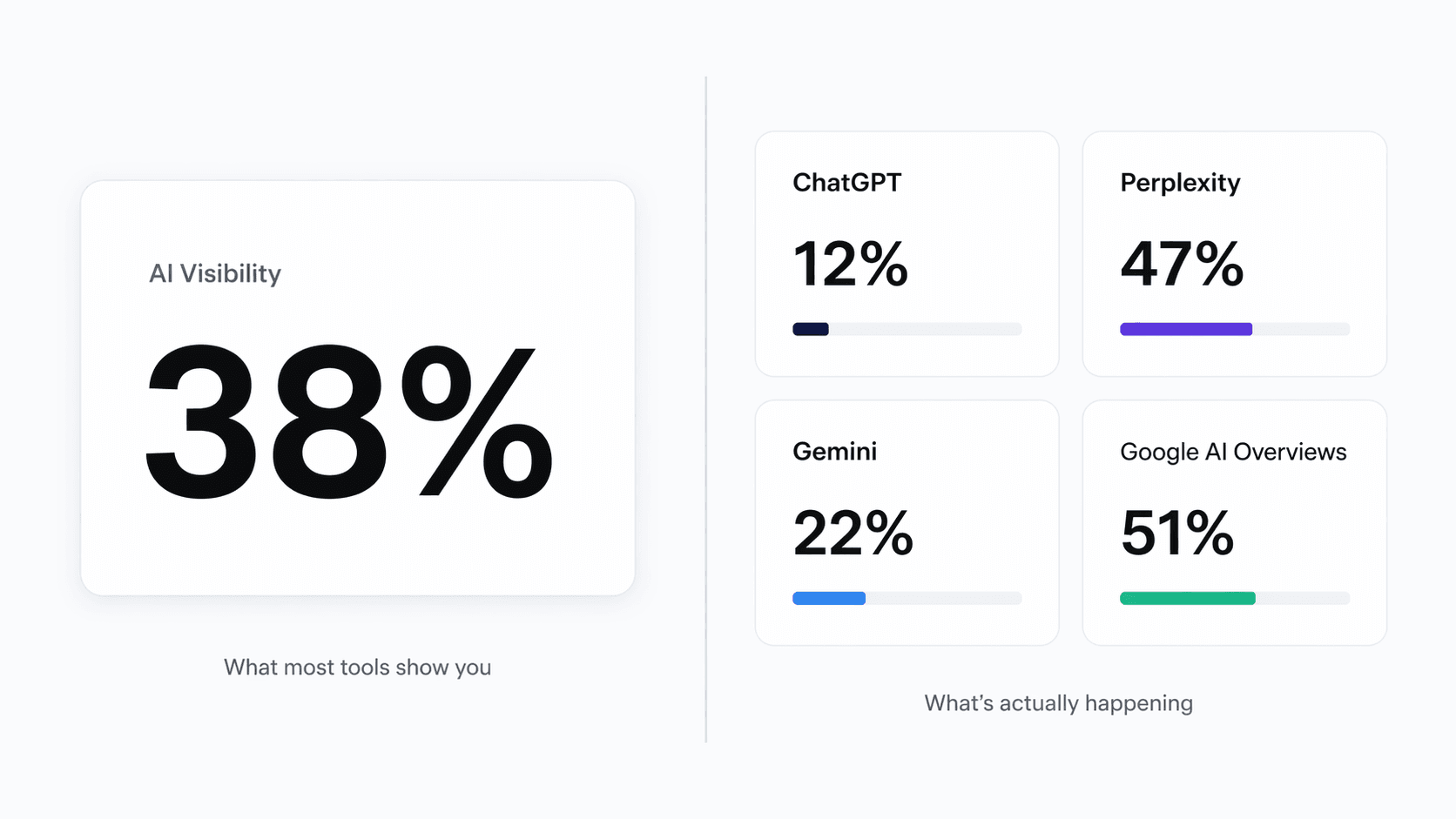
They prominently display a single visibility percentage for the entire brand, even though AI search visibility is a function of topic and LLM
Many get their data from the API of these LLMs, which returns very different results than the web version real users use
To top it off, these other options worked out as absurdly expensive, especially if you're tracking AI visibility for multiple clients.
In this article, I'm going to walk through the criteria that actually matter when choosing an AI visibility tool, why most tools fail on those criteria, and how the main options in this space stack up.
I'll also introduce our own tool, Traqer, and tell you why it's different.
Why AI visibility tracking is harder than it seems
AI search doesn't work like Google. And that means the tools built to measure it can't work like rank trackers. Specifically:
Tracking individual prompts doesn't make sense because the outputs are too personalized and random.
Run the same prompt through ChatGPT ten times and you'll get ten different answers. Different brands mentioned, different orderings, and different recommendations altogether.
While there are patterns in those responses, like the most prominent brands being mentioned in most of those outputs, there's no fixed ranking like you have when measuring SEO performance. Any tool that says that you rank in a certain position for a prompt is misrepresenting how LLMs work.
Also, outputs vary by person because LLMs, unlike Google, factor in a massive amount of personal context when generating their answers. If someone asks ChatGPT or Claude for the best project management tools, the LLMs will factor in all kinds of context about their business, industry, team size, budget, specific pain points and situations they've discussed before, and more.
So, prompts aren't like keywords where the same input produces roughly the same output. That means when measuring visibility, just guessing what prompt users are entering isn't enough. Your tool's response and a real users' response will be very different (Read more: Invisible Prompts ).
To account for this, instead of tracking individual prompts (i.e., keywords in SEO language), you should track your AI visibility on a topic basis, where a topic is a collection of related prompts. It flips the question from "Are we showing up for this prompt?" to "How often are we mentioned when this topic comes up?". The more you show up within a topic area, the more likely you are to appear when a real customer searches for a solution, however they prompt the LLM.
There is no single metric for AI visibility, it's a function of topic and LLM.
Another consequence of the topic-based nature of AI search is that a brand's "AI visibility" isn't one thing. It's very heavily a function of topic area and LLM. For some topics, core to the business, where they've had good brand awareness for many years, a brand may have really high brand awareness in all LLMs, for example. But for a different topic, like a new product line or niche of the market the brand is trying to enter, they may have almost zero visibility.
These details matter. But most visibility tools seem to prioritize and emphasize in their UX a single metric, namely a visibility percentage. They show a graph of this up front for every brand.
This is misleading, for one. But it also mis-aligns incentives for marketing teams. It's easy to manipulate a single brand wide visibility percentage. Simply stop tracking the topics and prompts that you're trying but not yet visible for and the percentage will go up. But that doesn't help the business. The team should be encouraged to track new ambitious topics and prompts. A good AI visibility tool should account for this.
APIs don't match web interfaces.
Most AI visibility tools send prompts to OpenAI, Perplexity, and Google through their APIs and report the responses. But these API responses are materially different from what a user actually sees in the web interface. LLM web products are layered with system prompts, interface controls, and tuning that shape tone, structure, and recommendations. A brand that appears prominently in an API response may not appear at all in the real web experience, and vice versa.
We discovered this early in Traqer's development and spent weeks rebuilding the tracking infrastructure around real web scraping: logged-out browser sessions that capture what a user would actually see. It required solving significant technical barriers, because LLMs actively resist scraping, but it became the foundation of everything.
Not all prompts are worth tracking.
LLMs don't usually mention brands for top-of-funnel queries. Ask ChatGPT "how does project management software work?" and it will probably explain concepts without recommending any tool. Ask "what's the best project management software for a remote team under 20 people?" and you'll get a list of recommendations.
Tracking top-of-funnel prompts inflates your apparent visibility because they generate responses where brands aren't mentioned—a 0% visibility on those prompts is irrelevant noise. The only prompts worth tracking are bottom-of-funnel queries where users are genuinely looking for product recommendations.
The criteria that actually matter when choosing an AI visibility tool
Not all tools in the AI visibility space are measuring the same thing, and some of the differences aren't obvious until you're looking at meaningless data you can't do anything with.
Here's what to evaluate before committing to any AI visibility platform.
1. Does it track at the topic level or the individual prompt level?
As we mentioned above, a single prompt run once produces one output in your tracking tool, but that output might not be reproducible tomorrow, or even an hour from now. What you actually need is to run multiple prompts that approach the same topic from different angles and look at the pattern across all of them. That's how you get a better idea about whether your brand shows up for a relevant topic.
Note: Our tracking tool, Traqer, organizes everything around topics. Each topic contains various prompts, and visibility is measured as the percentage of prompts within that topic where your brand appears, broken out by LLM. Multiple prompts within the same topic telling you "you showed up in 7 of them on Perplexity and 3 of them on ChatGPT" is data you can act on.
2. Does it track real web outputs or API outputs?
This is a really important foundational question, yet it's not widely known. If a tool uses APIs to query LLMs, the data it reports reflects model behavior in a stripped-down environment , rather than user behavior in the actual product.
3. Does it separate brand mentions from citations?
Most tools combine brand mentions and citations into a single visibility score, which isn't helpful. A brand mention means the LLM named your brand in its recommendations, which can drive direct leads. In contrast, a citation just means your URL appeared as a source link.
They tell you which content LLMs are drawing from—which might be useful for your content strategy—but it simply shows you've influenced the LLM's answer without being recommended as a solution. Brand mentions and citations are fundamentally different things, and your AI visibility tool should take this into account.
4. Does it break visibility out per LLM, or blend everything into one number?
Different LLMs behave very differently . For instance, Perplexity functions essentially as a search result summarizer, meaning brands with strong traditional SEO tend to have decent visibility there. But ChatGPT relies more heavily on training data, which means strong SEO doesn't automatically translate to strong ChatGPT visibility. A single blended visibility percentage across all models hides this nuance.
5. Can you afford to track multiple brands on it?
Several AI search visibility tools charge per brand and per LLM model, meaning tracking three client brands across five LLMs can cost several thousand dollars a month.
How the main AI visibility tools compare
The category has grown quickly. There are now tools aimed at individual brands, agencies, and enterprise teams, and the differences in pricing, methodology, and focus are more significant than they might appear.
Here's a full breakdown of the main options on the market right now.
AI visibility tools for SMEs and agencies
Traqer
Traqer is our product, built because we run a content marketing agency managing SEO/GEO for 25+ clients. We couldn't find an AI visibility tool that measured the right things at a price that worked for multi-brand tracking.
Traqer tracks AI brand visibility across ChatGPT, Perplexity, Google AI Overviews, and Gemini. You set up a brand in Traqer by entering your domain, a description of your products, target customers, and key differentiators. Traqer then organizes tracking into topics; collections of prompts that all approach the same buying-intent question from different angles.
The core interface shows three visibility metrics at the brand level:
LLM Visibility %: The percentage of tracked prompts where your brand appears, shown separately for each LLM. Similar to what other tools report, but never blended across models.
LLM Visibility Count: The raw number of prompts where your brand appears, per LLM. This metric only goes up when real progress happens.
Topic Visibility: The number of topics where you have some or high visibility. Non-gameable: you can't improve it by removing low-visibility topics.
The last two methods of measuring overall brand visibility are unique to Traqer and solve the problems mentioned above about measuring brand-wide visibility. Most AI visibility tools report a single visibility percentage: the share of tracked prompts where your brand appears. The problem is that this number moves when you change what you're tracking, not just when your actual visibility changes. Add ten new prompts you aren't yet ranking for, and your visibility percentage drops. Delete the prompts where you're weakest, and it jumps. Neither action reflects any real change in how LLMs are treating your brand.
This creates the wrong incentives. Teams end up avoiding ambitious tracking, or worse, intentionally removing low-visibility prompts to make sure leadership sees a higher visibility percentage.
Here's how LLM Visibility Count and Topic Visibility solve for this:
LLM Visibility Count simply records the raw number of prompts where you appear, per LLM. It's very simple but is a more honest and accurate way of measuring overall growth in a brand's AI visibility. Over time are you visible for more and more prompts? It also can't be as easily manipulated. You can add 100 new prompts and the count won't go down; it only increases when you genuinely gain visibility somewhere new, or where you weren't tracking before.
Topic Visibility works similarly: it tells you how many topics you have visibility on (we use two metrics: topics with some visibility and topics with high or greater than 50% visibility). Again, adding new topics doesn't hurt your existing scores. It only goes up if you genuinely have more topics where you have some visibility or you get more visibility for an existing topic.
Both metrics are straightforward to report to a client or executive because they only move in one direction: up, when something real has happened.
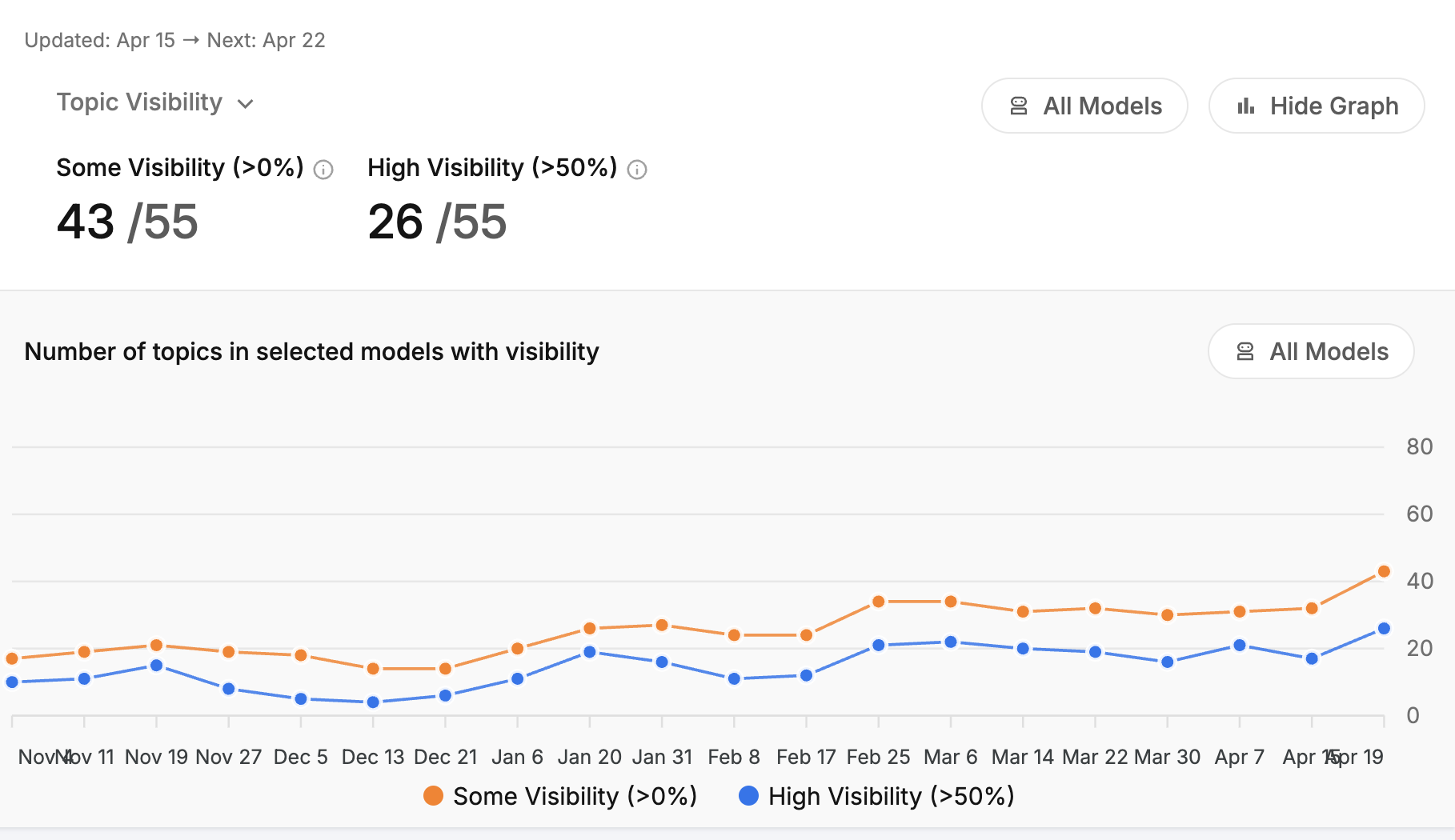
Below that, on every brand page, you see the full list of topics and every single prompt you are tracking for each topic, and where you're visible for each, without any scrolling or clicking required:
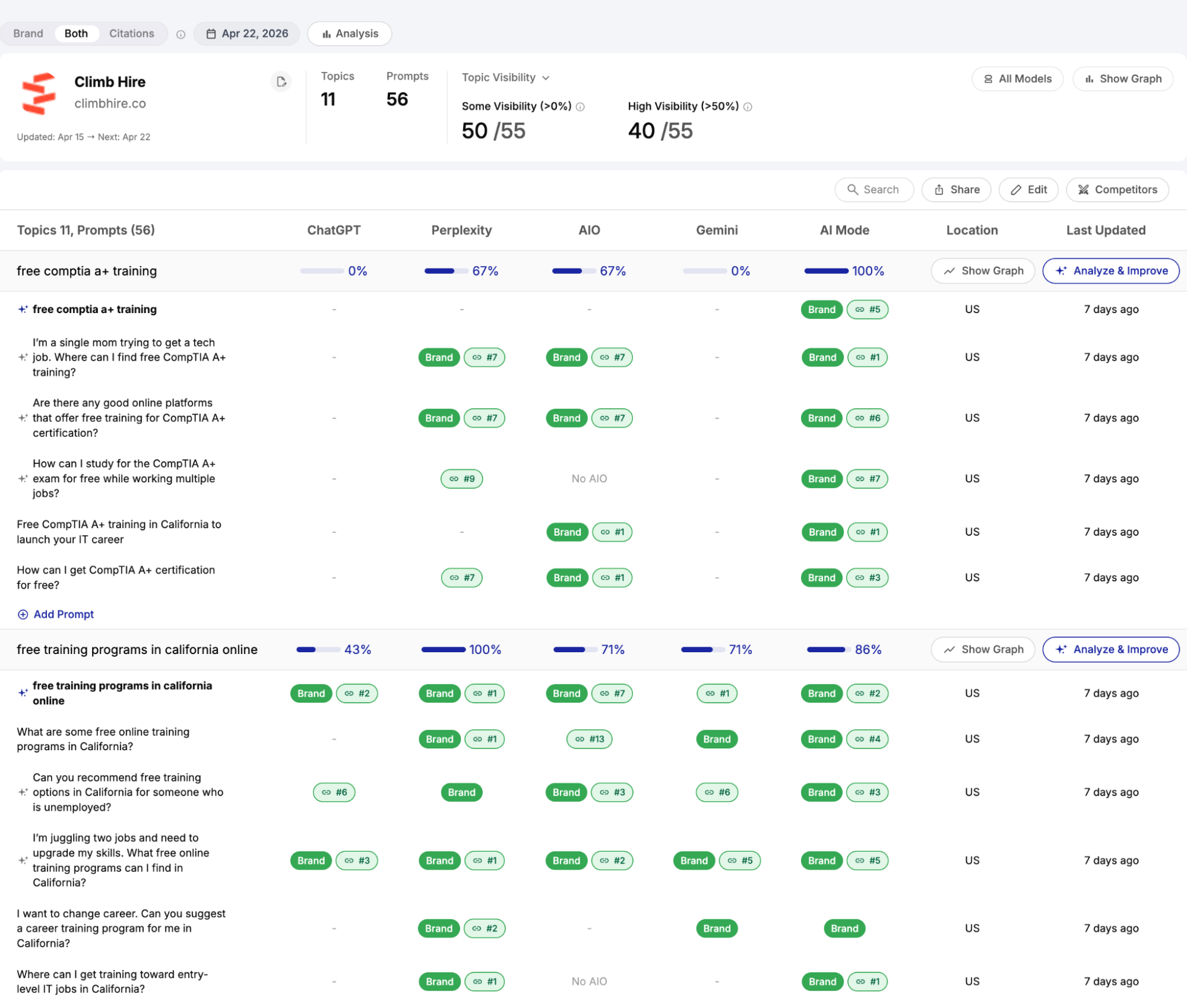
We found that many other tools we tried focused on the single brand visibility metrics and hid the details behind layers of clicks. But the details of where you are and aren't visible are the most actionable and useful information. That's where you learn where you need to improve (by, for example, publishing more content on a topic where you aren't as visible). So we built Traqer to show all of that detail, clearly, up front.
The brand above, for example, can see that they have really good visibility for prompts around training programs in California, but not as good coverage for the Comptia A+ training topic. Even more detailed, they can see that they have literally no visibility for the latter topic in ChatGPT and Gemini. This kind of information is critical to taking action to improve visibility but is often hidden behind many clicks in AI visibility tools.
Also note how Traqer clearly distinguishes between brand mentions and citations. Many tools count a brand mention and citation equally, even though brand mentions are far more valuable from a marketing perspective than simply being a cited source in an AI answer. There is even a toggle at the top of each brand page to only count brand mentions or citations, if you choose.
Each topic has an Analyze & Improve view that shows which brands LLMs mention most for that topic, which domains and specific URLs get cited, and a Brand Mention Probability rating for each prompt (High/Medium/Low). The probability rating helps you identify which prompts are genuinely worth tracking and which are informational noise where LLMs won't recommend brands anyway.
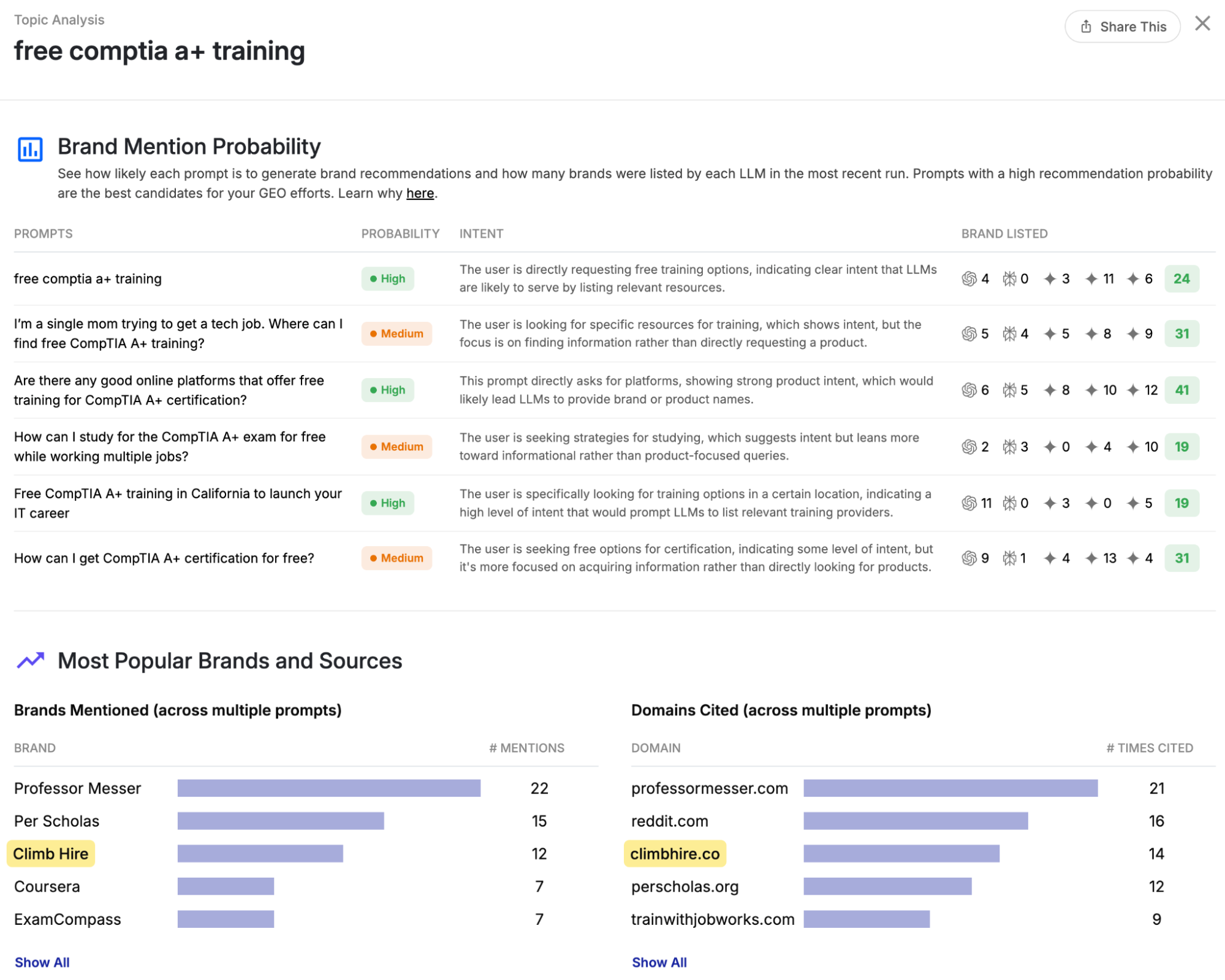
Clicking any prompt opens a view with a screenshot of the actual LLM response as it appeared in the real web interface—not an API response. You can see the ranked list of brand mentions, the cited URLs, and the full response text with your brand highlighted.
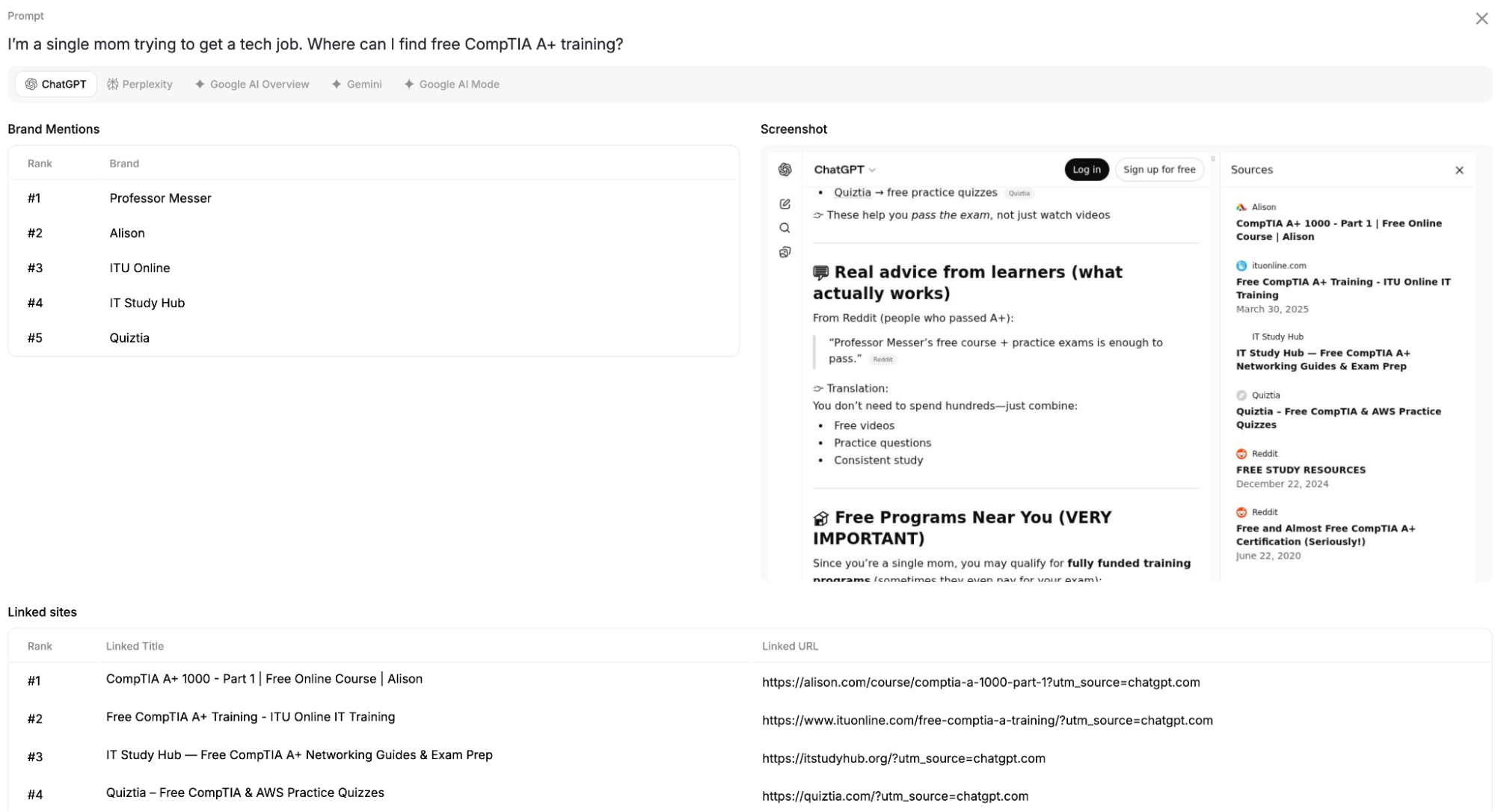
Data is refreshed on a weekly cycle, and you can compare any two past weeks side by side.
Pricing: From just $25 per month, giving you 10 topics and 50 prompts to track. Unlimited brands, unlimited users. Covering ChatGPT, Perplexity, AI Overview, Gemini, and AI mode.
Who it's right for: B2B SaaS marketers, marketing leaders who want to understand their AI search position across multiple platforms, and agencies managing multiple client brands. It's not a fit if you're looking for a tool to track thousands of prompts at high frequency because the weekly refresh cadence is designed for strategic visibility monitoring, not real-time alerting.
Otterly
Otterly positions itself as a more accessible entry point into AI visibility tracking. Setup is straightforward, the UI is clean, and the core function—monitoring brand mentions across AI responses—works as described. In our experience using Otterly (before building Traqer), the single-prompt tracking model was the biggest issue. Results from individual prompts have too much natural variability to be reliable on their own. Without a topic-based structure that aggregates multiple prompt variations, it's difficult to separate signal from noise. Otterly has been evolving its product, so this may have changed.
Scrunch AI
Scrunch is designed more explicitly for content and SEO teams, with features oriented toward discovering which content LLMs are citing and identifying gaps. If your primary use case is content strategy— figuring out what to write rather than tracking brand mention rates—Scrunch is worth evaluating. The AI visibility tracking features are present but secondary to the content discovery angle. For teams that primarily want brand-level visibility monitoring across multiple LLMs with per-LLM breakdowns, Scrunch's focus is somewhat different.
BrandRank.ai
BrandRank.ai covers brand monitoring in AI-generated answers and offers share-of-voice comparisons across competitors. The competitor benchmarking view is one of its stronger features for teams that want to understand how they stack up against a defined competitive set.
The concern with most tools in this space, including BrandRank.ai, is the blended visibility percentage problem. If visibility across five LLMs gets averaged into a single number, meaningful differences between platforms get hidden. A tool that's strong on Perplexity and weak on ChatGPT and a tool that's weak on Perplexity and strong on ChatGPT might report identical blended scores, despite requiring completely different content strategies to improve.
AI visibility tools for enterprise
Profound
Profound is one of the most established tools in the AI visibility tracking space. It covers a broad range of LLMs and has invested in reporting features that make it possible to share findings with stakeholders. The interface is polished and the product has clearly been built with enterprise use cases in mind.
The main limitation for agencies and multi-brand use cases is the pricing model: costs scale per brand, which makes tracking multiple clients or products expensive quickly. Profound also relies on API-based queries rather than real web scraping, which raises the same question about output fidelity that applies to most tools in this category.
For an enterprise brand with one product tracking its own visibility across a single market, Profound is a serious option. For agencies or companies with multiple brands to track, the per-brand cost structure becomes a meaningful constraint.
Peec
Peec is a VC-backed AI visibility platform founded in early 2025 and aimed at enterprise marketing teams. It tracks brand visibility across ChatGPT, Perplexity, and Google AI Overviews, with Claude, Gemini, and other models available as paid add-ons. The platform uses UI scraping rather than APIs (the same as Traqer) which means visibility data reflects what users actually see rather than what the API returns.
Peec's reporting is polished, with competitive benchmarking and regional tracking features that make it well-suited to larger organizations managing multi-market campaigns. The setup process is relatively straightforward, and the interface has a clean, dashboard-oriented feel.
The main consideration for most readers of this article is cost. The Starter plan begins at around €89/month for 25 prompts, but that base price only includes three LLMs. Tracking the full range of AI platforms adds €20-30 per additional model, which can push the effective monthly cost to €170-210 for comprehensive coverage—before factoring in the need for additional prompts. Peec charges per prompt and scales pricing by volume, so the economics depend heavily on how many prompts and how many models you need.
For an enterprise team with a budget to match, Peec is a credible option. For smaller teams or agencies managing multiple brands, the cost structure is difficult to work with, and the per-model add-on model adds friction to what should be a baseline capability.
What actually moves (meaningful) AI visibility
Tracking is only half the equation. Everyone searching for an AI visibility tool wants the same end result: their brand showing up more often in AI-generated recommendations. The tracking tells you where you stand. This section is about how you actually move the number.
The honest answer is that no one has a guaranteed playbook here. AI search is less predictable than traditional SEO, and the relationship between content actions and visibility outcomes isn't as direct. What we have at Grow and Convert, after working on GEO for 20+ clients, are two levers with strong supporting evidence—and a clear-eyed view of their limits.
Producing owned content that ranks.
Content on your own site that ranks for traditional SEO keywords related to a buying-intent topic tends to get cited by AI models, particularly by Perplexity and Google AI Overviews, which are search-based. If LLMs are pulling from search results, ranking in those results is the first step to getting cited.
Traqer's "Domains Cited" data shows whether your domain is among the sources LLMs are drawing from for each topic. If it isn't, producing content that ranks for those bottom-of-funnel queries is the starting point. This aligns with the first tier of the GEO Priorities Pyramid : owned content is the foundation.
What the data won't tell you is that ranking in Google doesn't guarantee LLMs will cite you. While the correlation is real (especially on search-based LLMs), it's not mechanical or predictable.
Getting mentioned on sites LLMs already cite.
Traqer's "Articles Cited More Than Once" data shows the specific pages LLMs pull from for each topic. These are the pages that matter. A review site, a comparison article, or an industry publication that shows up repeatedly across multiple prompts is a target worth pursuing—through outreach, guest contributions, or getting listed in existing roundups.
The logic here mirrors SEO link building, but the mechanism is different. In SEO, links signal authority. In AI search, third-party mentions signal that your brand is genuinely recognized in a category, not just self-described. LLMs appear to weight external validation heavily.
The limit: getting mentioned on a frequently-cited page doesn't guarantee the LLM then recommends your brand. You're influencing inputs, not controlling outputs.
What's the role of tracking in all this?
This is where a good AI visibility tool earns its place in your stack. Without tracking LLMs, you're producing content and doing outreach with no way to know whether any of it is working. With it, you can see whether your domain is appearing in the citation data, whether specific topics moved after a content push, and where your competitors are gaining ground across different topics. The tracking data frames the strategy and tells you whether your activities are working over time.
Which AI visibility tool is right for your business?
We've made our position clear throughout this article: topic-based tracking, per-LLM breakdowns, real web data, and pricing that doesn't penalize you for tracking more than one brand. If those criteria resonate, Traqer is built around all of them, starting at $25/month with unlimited brands. Start tracking at traqer.ai.
If you're an enterprise team with a larger budget and need polished stakeholder reporting or multi-market coverage, Profound and Peec are the options built for that scale. And if citation discovery is your primary concern rather than brand mention monitoring, Scrunch is worth a look.
Whichever LLM tracking tool you choose, the questions from the criteria section are worth putting directly to any vendor: What data source does the tool use—API or real web interface? How is the visibility percentage calculated, and does adding prompts affect it? Are brand mentions and citations reported separately? The answers tell you more about a tool's usefulness than any feature list.
Traqer is built by Grow and Convert. If you want to go deeper on the GEO strategy behind AI search visibility—not just the tracking, but the content approach—the Topic-Based GEO article and Prioritized GEO article are the right starting points.