
AI Visibility Tracking Tools for Agencies: What We Found
When we started tracking AI visibility for our clients (at Grow and Convert), pricing was the first thing that caught our attention. Run the numbers on tools in this space for a multi-client agency and you're looking at hundreds, sometimes thousands, of dollars per month.
We built Traqer because the math didn't work for our agency, and we knew we weren't the only ones. But pricing wasn't the only issue. The tools we tried also had a measurement problem. They reported a single blended visibility percentage across all LLMs, tracked individual prompts as if they were stable like search keywords, and pulled data from LLM APIs rather than the real web interfaces where users actually search.
This meant they weren't telling us what our clients needed to know about where they were showing up.
This article covers what actually matters when you're choosing an AI visibility tool for your agency, and how the main options in the market shape up.
What many AI visibility tools for agencies get wrong
Most tools in this space become prohibitively expensive for anyone tracking multiple clients. If you're covering 10 clients with 25 prompts each across five LLMs, one of the well-known options we tried would run around $1,500/month; and that's before you've meaningfully scaled prompt volume per client. For most agencies, and definitely for us, that is more than double the cost of any other software in our stack, including our everyday-use SEO software. We don't know any agency owners who are excited or even ready to pay more for AI visibility software than all the other existing software in their stack.
But more importantly, in this case you'd be spending all this budget for data that doesn't help you much.
How so? This is what we noticed:
Most tools track individual prompts, not topics. Run the same prompt through ChatGPT 10 times and you'll get 10 different responses. Unlike SEO rankings, there's no fixed position to track. Any tool that says your brand is "in position 2" for a prompt isn't accurately presenting how LLMs work. Instead, you should be tracking topics; clusters of related prompts that point to the same buying-intent question from different angles. You should be looking for a pattern of performance across these.
Most tools use APIs, not real web interfaces. Querying LLMs through an API means that the tool is reporting on responses that are materially different from what users see in the real LLM. Without getting too technical, LLMs layer system prompts, interface controls, and product-level tuning on top of their base model. This means that a brand appearing in a "pure" API response might not appear to real-life users.
Most tools report a single blended visibility percentage across all LLMs. There are two problems with this. First, a brand with strong traditional SEO might look great on Perplexity but have much lower visibility on ChatGPT, but one number hides that. Second, the metric moves when you change what you're tracking, not just when your visibility changes. Delete the prompts where you're not appearing and the percentage improves. But nothing has actually changed.
AI visibility tracking tools for agencies
There are several tools in this space worth knowing about. Here's how they compare for agency use.
Traqer
We built Traqer because we manage SEO/GEO for dozens of clients. We couldn't find anything affordable for agencies, and soon realized that the measurement approach of these tools was flawed.
Traqer starts at $25/month for 10 topics and 50 prompts. Unlike most tools, there's no per-brand charge and no per-LLM add-on costs. You get ChatGPT, Perplexity, Google AI Overviews, and Gemini at every plan level, and you can track unlimited brands and add unlimited users. The cost scales only with prompt volume, which means adding a new client doesn't change your pricing unless you need to add prompts.
To put that in concrete terms: 25 clients, each with 20 prompts is 500 prompts in total. That lands in Traqer's top-tier pricing, but this still works out at a fraction of what comparable coverage would cost on other tools.
How Traqer works
Traqer is built around topics rather than individual prompts. You set up a topic (e.g., "best project management software for small businesses") and Traqer generates multiple prompts that approach the topic from different angles. Visibility is reported as the percentage of those prompts where your brand appears, broken down per LLM. This gives you a stable signal rather than the noise of any single prompt response.
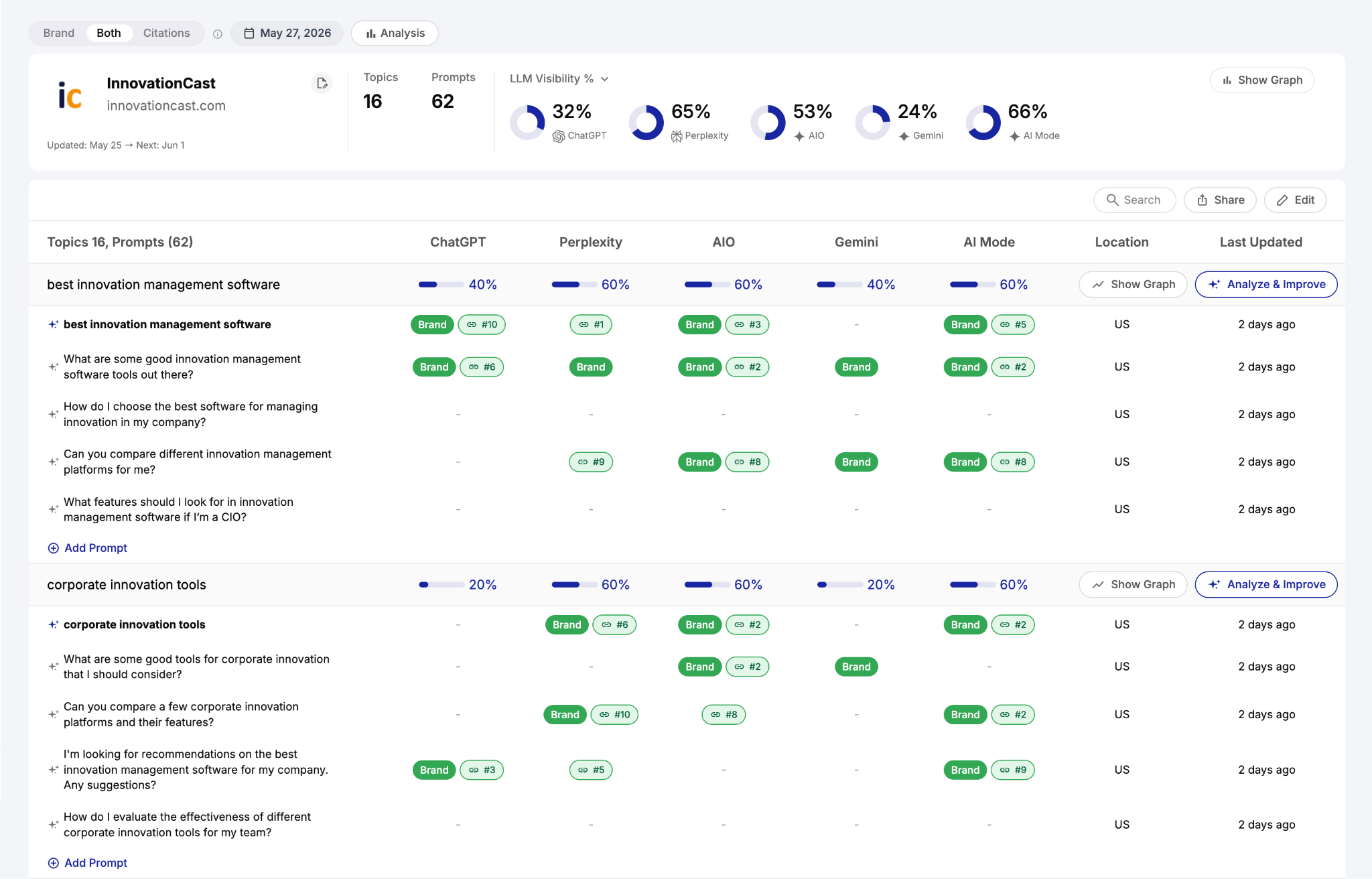
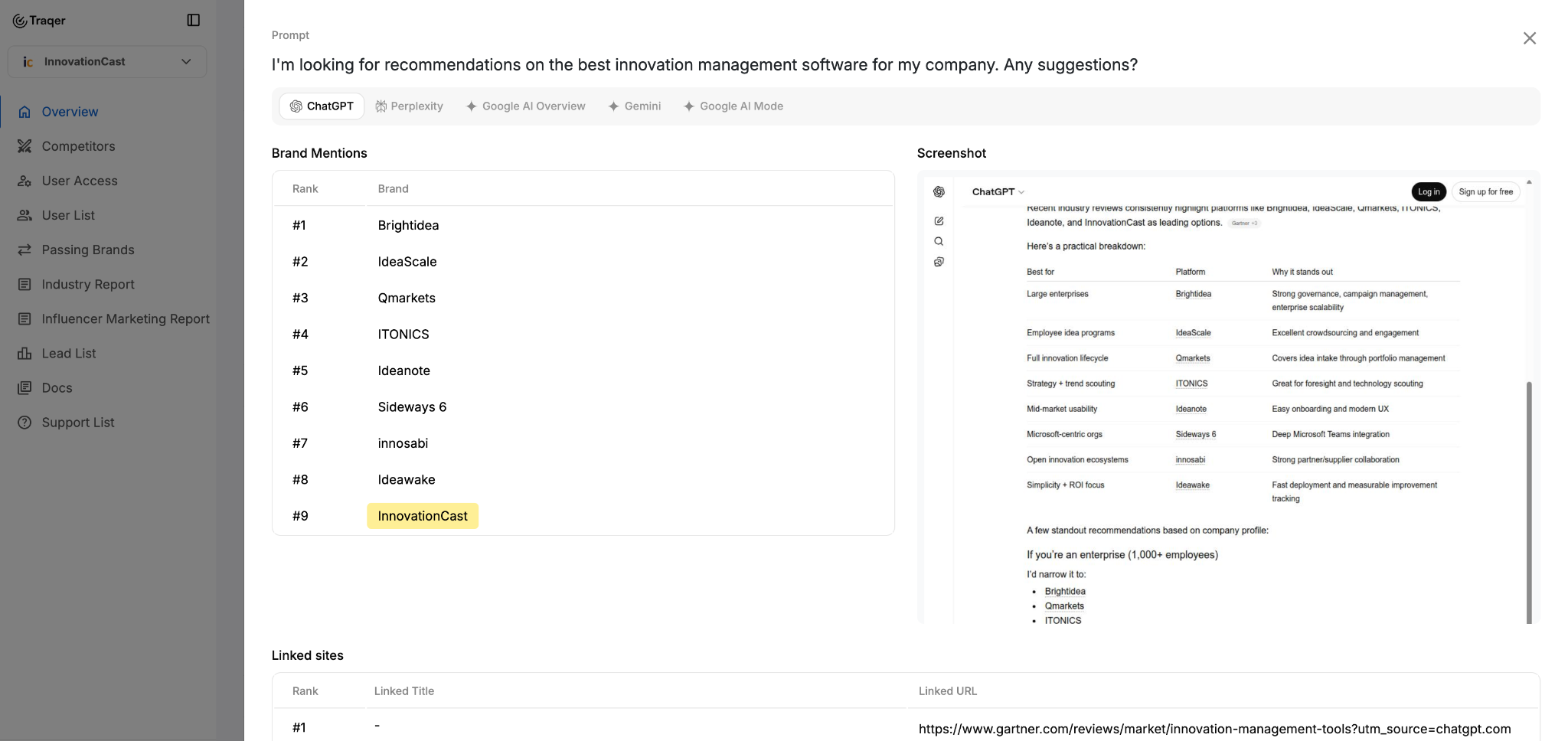
The data we use comes from real web interface scraping, not APIs. We spent a chunk of development time (blood, sweat, and tears) on building it this way, because LLMs actively resist scraping. But we believe it's the only way to capture what users actually see. Every prompt contains a screenshot of the actual response from the real LLM interface attached to it.
On the metrics side, we offer three visibility measures at the brand level:
LLM Visibility %: Percentage of tracked prompts where the brand appears, shown separately per LLM.
LLM Visibility Count: Raw number of prompts where the brand appears, per LLM. This number only goes up when visibility genuinely improves. Adding new prompts doesn't reduce it.
Topic Visibility: Number of topics where the brand has high (>50%) or some (>0%) visibility. Adding new ambitious topics doesn't drag this metric down.
The last two matter in particular, because, as mentioned, a standard visibility percentage is easy to manipulate. Stop tracking the prompts where you're not appearing and the percentage improves. LLM Visibility Count and Topic Visibility don't work that way. They only move when something real happens.
Traqer also separates brand mentions from citations. A brand mention means the LLM named the brand in its recommendation. A citation means the brand's URL appeared as a source link. Most tools combine these into one number, but they mean different things. A client being cited heavily but rarely mentioned by name has a different problem than a client who isn't appearing at all. The data should tell you which it is.
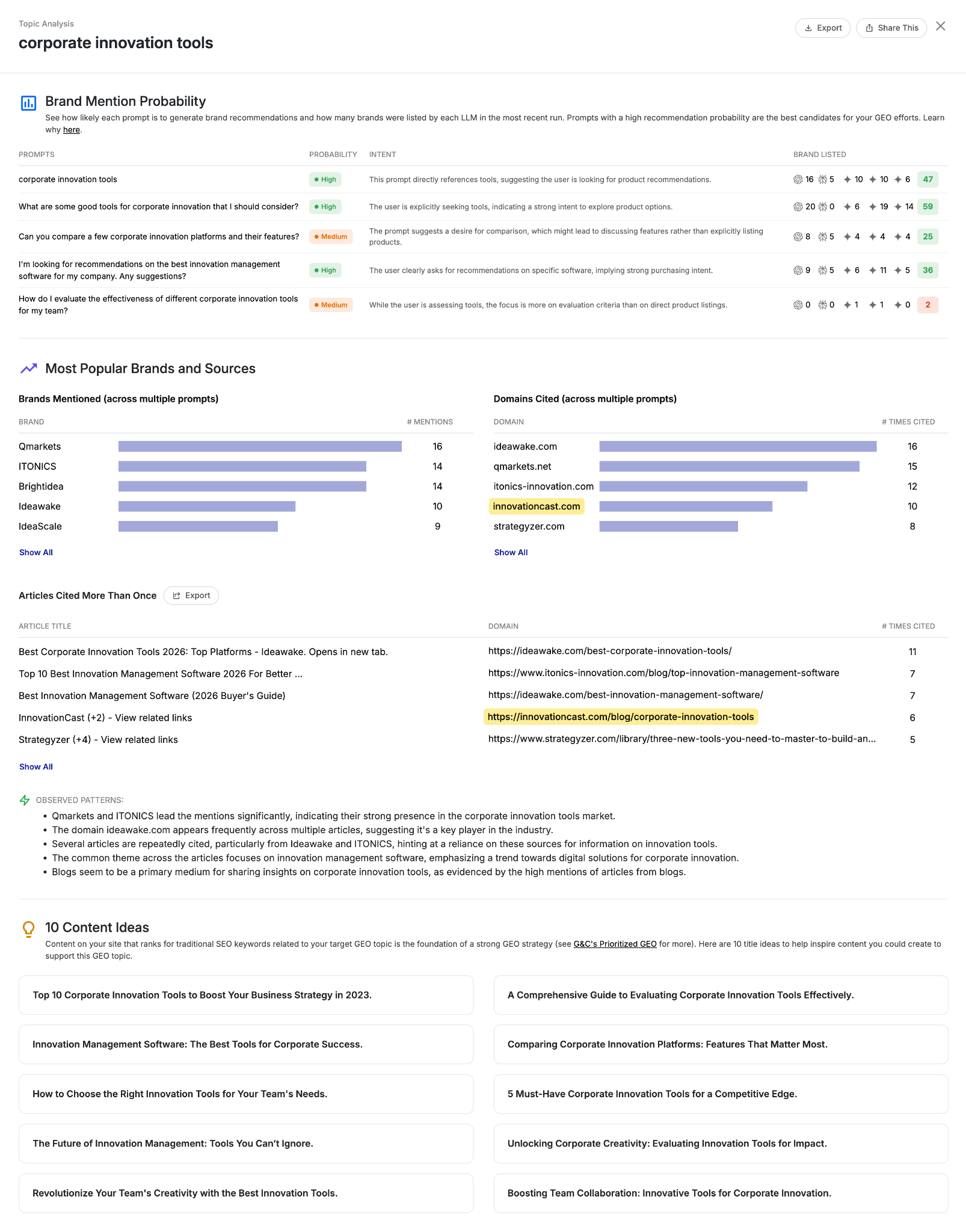
Each topic has an Analyze Improve view that shows which brands appear most in LLM responses for that topic, which specific pages LLMs are citing, and content ideas based on what's being cited. This is how you identify what to do next. For instance, which content to produce, which publications to target for mentions, and which prompts are informational noise not worth tracking.
Traqer updates weekly and has date comparison built into the core interface, so you can pull up any two tracking dates and see what shifted at both the brand level and the topic level. That's the view that makes client conversations concrete: ChatGPT visibility on this topic went from 20% to 45% between these two dates, here's which prompts moved, here's what we think caused it.
Start tracking your clients' AI visibility with Traqer
Scrunch AI
Scrunch is popular with content and SEO teams. Its strength is content strategy: discovering which sources LLMs are citing, identifying gaps, and helping you understand what to produce. If that's a core part of what you deliver to clients, it's worth a look. It's less focused on visibility tracking and reporting across LLMs, which is where most agencies will spend the majority of their time. Worth checking their pricing at your actual client count. They're at the lower end of the market, which helps.
Profound
Profound is the most established enterprise option in this category. The product is polished, the LLM coverage is broad, and the reporting features are built for sharing with stakeholders. It's clearly designed for large in-house marketing teams tracking one brand in depth; Lite starts at $499/month. For agencies, that price point is the obvious constraint. If you're managing a small number of high-budget enterprise clients who can absorb the cost, it's worth evaluating. For most agency client lists, the economics don't work.
Peec
Peec is a VC-backed platform that launched in early 2025 and has grown quickly. It covers ChatGPT, Perplexity, and Google AI Overviews natively, with Gemini, Claude, and others available as paid add-ons. Like Traqer, it uses real web scraping rather than APIs, meaning the data quality issue applies less here. The main constraint, however, is the cost structure. The Starter plan is €89/month for 25 prompts, covering three LLMs. Full LLM coverage adds €20–30 per additional model. For a single brand with a generous budget, that's manageable. For an agency tracking ten or fifteen clients, the per-model add-on structure makes comprehensive coverage expensive before you've scaled prompt volume at all. Peec has raised significant funding and is investing in polished reporting and enterprise features. It's a serious product, but the agency economics are difficult to make work at anything below the higher end of the market.
What actually improves AI visibility, and what agencies should be doing about it
GEO is arguably much less predictable than SEO. There's no equivalent of a keyword ranking that maps cleanly to a specific action. But that doesn't mean it's a black box. Based on our work across dozens of clients, there's a clear hierarchy of what moves the needle and what sounds plausible but doesn't help.
Start with bottom-of-funnel content, not top-of-funnel
Many content strategies are still built around informational, top-of-funnel topics. That approach is increasingly difficult to justify, even for traditional SEO. For AI search, it's essentially a dead end. When someone asks ChatGPT "what is project management software" the LLM answers the question itself and mentions no brands. There's nothing for your client to gain there.
The only queries worth targeting for AI visibility are bottom-of-funnel queries where the user is actively looking for a product recommendation: "best project management software for remote teams," "Asana alternatives for small businesses," "top SaaS content marketing agencies." For these types of prompts, LLMs respond by listing brands. Your goal is to make sure your client is one of those brands.
This isn't a new insight for agencies already running Pain Point SEO strategies. The bottom-of-funnel content that drives conversions from organic search is the same kind of content that drives AI visibility. The strategic overlap is significant and definitely worth communicating to clients.
The mechanism: LLMs search the web for product queries
Understanding why bottom-of-funnel content works requires understanding how LLMs actually generate product recommendations. For informational queries, LLMs draw from training data and answer directly. For product-centric queries, they almost always search the web first, because they know their training data doesn't contain current product information. ChatGPT has said as much in its own documentation.
This means AI visibility, for the queries that actually matter, is fundamentally linked to traditional search visibility. If your client's content ranks in Google for a relevant buying-intent keyword, there's a reasonable chance that an LLM will encounter and cite it when generating a product recommendation response. This is why domain authority and existing SEO performance correlate with AI visibility. They're driven by the same underlying signals.
The practical implication is that the foundation of GEO strategy is owned content that ranks for bottom-of-funnel keywords.
Off-site brand mentions amplify what owned content establishes
Getting ranked in organic search for the right queries is the first priority. Then it's about getting your client mentioned in third-party content that LLMs are already citing.
When LLMs search the web for product recommendations, they pull from review sites, comparison articles, industry roundups, and community discussions, not just company websites. A brand that appears repeatedly in these third-party sources gets exposed to LLMs through multiple routes. From our research, this appears to increase the likelihood of being recommended.
Practically, you need to identify what specific LLMs are citing for a given topic, then pursue mentions on those pages through outreach, guest contributions, expert quotes, or getting listed on existing roundups. (Traqer can help you with this). This actually mirrors traditional link-building, but the goal is exposure to LLMs rather than to get a particular article to rank or to build up domain authority.
It's important to note, however, that getting mentioned on a frequently-cited page doesn't guarantee the LLM then recommends your client. Here you're influencing the inputs rather than controlling the outputs. LLMs synthesize across multiple sources and make their own determination. The strategy has strong supporting logic and we've seen it work consistently across clients, but there's no guaranteed outcome.
What doesn't work for improving AI visibility
The most-hyped GEO tactics, such as adding llms.txt files, restructuring headings as questions, adding FAQ sections and key takeaways, implementing AI-specific schema, are the least effective in our tests.
These approaches are designed to help LLMs better understand content once they reach it, but they don't address the more fundamental problem: whether LLMs encounter the content at all. A well-structured page that doesn't rank for anything relevant to a product query won't gain AI visibility through on-site optimization. We've tested these tactics across clients and seen no measurable impact. They're worth experimenting with at the margins, but they shouldn't come at the expense of what we recommend above.
Which tracking tool is right for you?
Without a tracking tool, GEO is just a set of reasonable hypotheses with no feedback loop. But there are two questions worth answering before committing to any AI visibility tool: what does it cost at your client count and prompt volume, and does it measure what LLM users are actually seeing?
If you have enterprise-budget clients who need polished reporting and deep LLM coverage, Profound and Peec give you options at the higher end of the market. If you want an affordable option with data from real web interfaces, topic-based tracking, per-LLM breakdowns, and brand mentions separated from citations, Traqer might be the one to try. It starts at $25/month with unlimited brands.
Traqer is built by Grow and Convert. For more on the GEO strategy behind improving AI visibility, Topic-Based GEO and Prioritized GEO explain the thinking behind how Traqer was built.